
One Person, One Teacher, One Hour: Why Private Pilates Is Having Its Moment Back
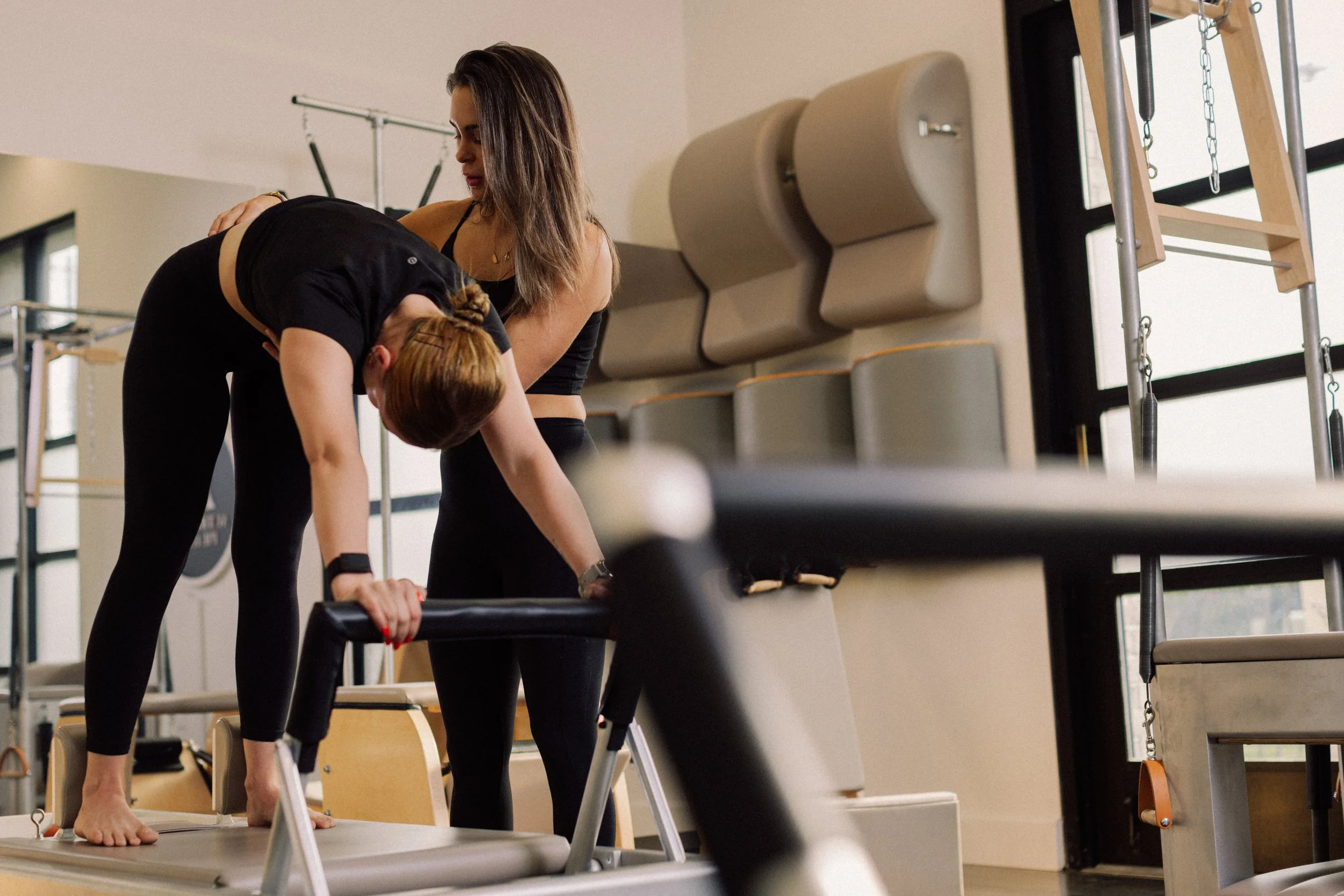
Here's something most people don't know about Pilates: it was never designed for a group class.
Joseph Pilates worked with his clients one on one. His studio in New York City was not a group fitness floor. It was a room full of apparatus and one teacher who knew every single person who walked through the door. He knew their bodies, their histories, their tendencies, and their potential. He worked with dancers recovering from injuries, athletes building strength, and ordinary people who just wanted to move better. Each of them got his full attention.
The group class came later. The 12-person reformer class, the boutique fitness model, the studio packed wall to wall. It came because it scaled, and scaling a business is a reasonable thing to want. But somewhere in that expansion, something got lost.
The industry and clients are starting to notice.
What a Large Group Class Can't Do
In a group class, the instructor cannot really watch you closely. They're watching the room, scanning, cuing to the average, managing the pace. If you tend to hyperextend your knees, or your shoulder doesn't rotate the way it should, or you've developed a habit of gripping through your hip flexors to compensate for a weak core, the instructor may not catch it. They might eventually. But probably not in session one, and maybe not even in session twenty.
That matters because the whole point of classical Pilates is precision and moving with alignment. It's not about moving more. It's about moving better. And moving better requires feedback, adjustment, and real attention that simply cannot be delivered to twelve people at once.
Group classes can be energizing and motivating, and they can be a good supplement once you already understand the work. But they can't give you what a private session gives you.
What a Private Session Actually Is
A private Pilates session is not a luxury. It's the original product.
When you work with a skilled instructor one on one, here's what you're actually getting:
A session built around your body, not a curriculum. Your instructor starts from an honest look at how you move, what you need, and where you are that day. The plan adjusts in real time. Nobody is following a script.
Correction that is actually meant for you. When your instructor says "drop your shoulder" in a private session, they mean your shoulder, in this moment, for a specific reason. That specificity is the difference between a cue that lands and one that floats past you.
Progress that is tracked and intentional. A skilled instructor is building a picture of your body over time. They remember what shifted last session, what you've been working toward for three months, what compensation keeps showing up. That kind of sustained attention isn't possible in a group.
The full apparatus. Classical Pilates uses a system of equipment, the Reformer, the Cadillac, the Wunda Chair, the Barrel, and more, designed to work together. Each piece prepares the body for the next. In a group class you usually see one or two pieces. In a private session a trained instructor can move through the whole system in an hour and give you exactly what you need.
Why the Industry Is Coming Back to This
If you've watched the fitness world over the past few years, you've seen it. People try the big reformer studios, go for a while, and one of two things happens. Some quietly stop. Not always because of the cost, but because they got bored, because they stopped progressing, because they were doing exercises that had nothing to do with what their body actually needed, moving for the sake of moving with nothing to show for it over time. Others keep going, and that's where it gets more concerning. They push through a nagging pain, they work around a discomfort that never quite goes away, and because nobody in that room is paying close enough attention to notice, something small becomes something bigger than it ever needed to be. More sessions didn't help them. More effort didn't either. What they needed was smarter movement, not more of it.
At the same time there's been a genuine turn toward personalized care across a lot of areas. Concierge medicine. Personalized nutrition. Individual coaching. People are figuring out, in field after field, that the mass-market version of a thing is not the same as the real thing.
Pilates is part of that shift. More and more people are seeking out instructors who work privately, who take time to actually understand their bodies, who teach the method with integrity rather than with high energy and curated playlists.
This isn't a new development. It's a return to where the method started.
Who Benefits Most from Private Sessions
Most people benefit from private Pilates instruction, but there are some situations where it really matters:
Injury recovery or chronic pain. If you're working through a back issue, recovering from surgery, managing a chronic condition, or dealing with anything complicated in your body, a group class is not the right place. Your needs are too specific.
People new to Pilates. Starting in a group class means learning a new movement language while keeping pace with everyone around you. A few private sessions to build the foundation first changes the whole experience.
Athletes and performers. If your body is your instrument, the detail and personalization of private work produces results that group sessions can't match.
Anyone who genuinely wants to change something. If you're serious about moving differently, reducing pain, building real functional strength, or working on your body with intention over time, private sessions are where that happens.
A Slower, Better Thing
Private Pilates sessions are quiet. There's no loud music, no crowd energy, no one to pace yourself against. It's you and a teacher, and the work.
That can feel unfamiliar if you're used to fitness as a group experience. But most people find, once they've had a few private sessions, that it's actually what they were looking for the whole time. Something that pays attention to them rather than just moving them through the hour.
Joseph Pilates understood this from the beginning. The industry is finding its way back to it.
We never left.
At Authentic Pilates, we excel and specialize in private sessions. It’s truly our passion. That's not a premium offering; it's just the way we teach. If you're ready to work that way, we'd love to hear from you. Send us an email or book your session on our schedule here.
Authentic Pilates NC — 601 W. Smith Street, Greensboro, NC 27408helloauthenticpilates@gmail.com | 336-202-2365